Port of Prince Rupert
Port Overview
The Port of Prince Rupert is North America’s closest deep-water port to Asia and one of the fastest-growing gateways for shipping from China to Canada. Located on Kaien Island on British Columbia’s north coast, approximately 700 kilometres north of Vancouver, the port offers the shortest ocean route from Chinese ports to North America — typically 1–2 days faster than Vancouver and up to 3 days faster than Seattle or Tacoma. With capacity for over 1.8 million TEUs annually and one of the deepest natural harbours on the continent, Prince Rupert has become the preferred alternative for importers seeking speed, reliability and congestion-free operations. For official schedules, tariffs and operational updates, visit the Port of Prince Rupert official website.
Why the Port of Prince Rupert Matters for China Importers
- Closest to Asia: At roughly 10,600 km from Shanghai, Prince Rupert is the shortest sea route between Asia and North America — saving 1–3 days of ocean transit versus southern West Coast ports.
- Deepest Natural Harbour: With natural depths of 20+ metres and negligible tide restrictions, the port accommodates the largest container vessels afloat — up to 24,000 TEU class — without dredging or tidal scheduling.
- Congestion-Free Operations: With only one container terminal, vessel wait times at Prince Rupert are consistently the lowest on the West Coast — often zero days at anchor even during peak season.
- Single-Rail Advantage: The port is served exclusively by CN Rail, whose northern mainline offers 2,000+ kilometres of uncongested track to Chicago, Memphis and the US Midwest.
- Rapid Growth Trajectory: Container volume has grown from under 200,000 TEUs in 2007 to over 1.6 million TEUs annually, with major expansion projects underway to double capacity.
- Clean, Reliable Power: The port operates on hydroelectric power with some of the lowest greenhouse gas emissions of any major container gateway in North America.
Key Facts at a Glance
| Metric | Value |
|---|---|
| Annual Container Volume | ~1.6–1.8 million TEUs |
| Harbour Depth | 20+ metres (natural) |
| Container Terminals | 1 (Fairview Container Terminal) |
| Rail Connectivity | CN Rail (northern mainline) |
| Distance from Shanghai | ~10,600 km |
| Key China Trade Lanes | Shanghai, Ningbo, Shenzhen, Xiamen, Qingdao |
Port Location
The Port of Prince Rupert is situated on Kaien Island at the confluence of the Skeena River and Hecate Strait, approximately 700 kilometres north of Vancouver. The port’s location at the terminus of the Trans-Canada Highway and the CN northern mainline places it strategically closer to Asia than any other major North American gateway — a full 48 hours of sailing time closer than Seattle and 1–2 days closer than Vancouver.
Service Region
- Asia-North America shortcut: Prince Rupert’s great-circle route from Shanghai, Ningbo and Hong Kong is shorter than routes to any other major West Coast port, cutting both distance and sailing time.
- US Midwest corridor: CN Rail connects the port directly to Chicago (4–5 rail days), Memphis (5–6 days) and the US Gulf Coast — a highly competitive alternative to all-water services through the Panama Canal.
- Western Canada: Vancouver, Calgary and Edmonton are served by CN rail connections, though trucking distance is greater than from Vancouver proper.
- Northern BC resource economy: The port also serves the region’s forestry, mining and energy sectors through its breakbulk and bulk facilities.
Port Terminals
The Prince Rupert Port Authority (PRPA) operates a landlord model, with private operators managing terminal facilities. The port’s container operations centre on a single, highly efficient terminal.
Major Container Terminal
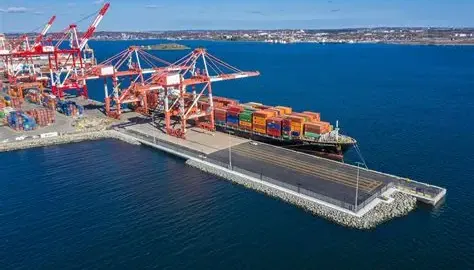
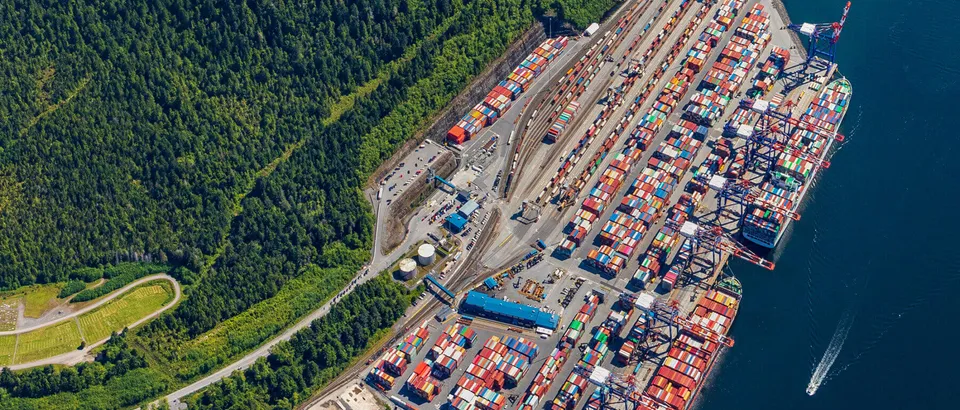
- Fairview Container Terminal (FCT): The port’s container facility, operated by DP World under a long-term concession. With over 1.8 million TEUs of annual capacity, FCT features 3 deep-water berths, 8 ship-to-shore cranes (expanding to 11), and on-dock rail with direct CN access. The terminal’s natural 20-metre depths accommodate the largest vessels afloat without tidal restrictions, and its expanded footprint adds 400,000+ TEUs of capacity through the Ridley Island property. A $100+ million phase expansion is underway to extend the wharf and add additional rail tracks.
Beyond containers, the port operates Ridley Terminals (coal and forest products) and Prince Rupert Grain (grain exports), which share the harbour’s deep-water infrastructure.
Shipping Routes to This Port
Prince Rupert is served by dedicated transpacific services from China’s major container ports, primarily through the 2M Alliance (Maersk and MSC) and THE Alliance service strings.
From Shanghai
Shanghai is the primary origin for Prince Rupert-bound cargo, with weekly sailings via Maersk’s TP1 service and MSC’s services. At roughly 10,600 km, Shanghai–Prince Rupert is the shortest ocean route between Asia and North America, with transit times of approximately 11–14 days.
From Ningbo
Ningbo-Zhoushan is a major feeder origin for Prince Rupert services, frequently paired with Shanghai on the same rotation. Weekly sailings provide consistent capacity from the Yangtze River Delta manufacturing heartland.
From Shenzhen (Yantian / Shekou)
Yantian and Shekou connect to Prince Rupert via weekly transpacific services, with transit times of approximately 13–16 days. Shenzhen’s consumer electronics and appliance exports are a major cargo source for the port.
From Xiamen and Other Ports
Xiamen, Qingdao and secondary Chinese ports connect to Prince Rupert through weekly services and feeder connections via Shanghai or Hong Kong, adding 2–4 days to total transit.
Transit Time from China to Prince Rupert
Prince Rupert offers the fastest ocean transit from China to any North American port:
| Origin Port | Transit Time to Prince Rupert | Sailing Frequency |
|---|---|---|
| Shanghai | 11–14 days | Weekly |
| Ningbo | 12–15 days | Weekly |
| Shenzhen (Yantian) | 13–16 days | Weekly |
| Xiamen | 14–17 days | 1–2 per week |
| Qingdao | 15–18 days | 1–2 per week |
The combination of short ocean transit and uncongested port operations (minimal vessel wait times) makes Prince Rupert’s total door-to-door times highly predictable. For LCL (Less-than-Container-Load) shipments, add 3–5 days for consolidation and deconsolidation. Importers should verify current service schedules, as sailing frequency is lower than Vancouver’s daily services.
Shipping Cost from China to Prince Rupert
Ocean freight rates from China to Prince Rupert are competitive with — and often slightly below — Vancouver rates, due to the shorter sailing distance and lower congestion costs.
Factors Affecting Freight Rates
- Shorter distance, lower fuel: The 1–3 day sailing advantage translates into lower bunker costs, which carriers partially pass through to shippers.
- Limited carrier options: With fewer service strings than Vancouver, rate negotiation power is concentrated among fewer carriers — working with a forwarder is essential to access competitive pricing.
- Seasonality: Peak season (August–October) rates can increase 30–50%, though Prince Rupert’s lack of congestion reduces the demurrage and detention risk that inflates total costs elsewhere.
- Port fees: Prince Rupert’s terminal fees are generally $50–$100 lower per container than Vancouver’s, reflecting lower congestion and simpler operations.
How to Lower Your Shipping Costs
| Strategy | Potential Impact |
|---|---|
| Combine ocean transit with CN rail to US Midwest | Often cheaper than all-water Panama Canal routes |
| Ship FCL instead of LCL | 30–50% lower per-unit freight cost |
| Book during off-peak (March–July) | 20–40% rate reduction |
| Work with a forwarder on alliance space | Access to volume-negotiated rates |
| Plan around the weekly sailing window | Avoid missing a departure and paying expedited rates |
Partnering with a China-based freight forwarder like DANTFUL gives importers access to competitive carrier contracts and expert guidance on Prince Rupert’s schedules and rail connections.
Warehousing Services
The Prince Rupert region offers a growing warehousing and logistics ecosystem anchored by the Ridley Island Industrial Park — a designated Special Planning Area with land available for warehousing, transloading and value-added processing.
Bonded Warehousing
As a designated gateway port, Prince Rupert supports Customs Bonded Warehouse operations, allowing importers to store goods without immediate payment of duties and taxes. Duty deferral supports seasonal inventory management and value-added processing before goods enter the Canadian market.
Overseas Warehousing & 3PL
The port’s growing 3PL ecosystem offers:
- Container deconsolidation and transloading services
- Transloading from ocean containers to domestic trailers for CN rail shipments to the US Midwest
- Breakbulk and project cargo handling
- Inventory staging for Western Canadian and US Midwest distribution
Warehousing & Distribution Strategy
For importers targeting the US Midwest or Western Canada, Prince Rupert offers a distinctive advantage: containers can move by CN rail directly to Chicago or Memphis without touching congested West Coast highway networks. DANTFUL partners with vetted logistics providers in the Prince Rupert region, offering end-to-end solutions including customs brokerage, transloading and rail coordination.
Frequently Asked Questions
Q: Why choose Prince Rupert over Vancouver?
A: Prince Rupert offers a shorter ocean transit (1–2 days faster from China), consistently lower congestion (minimal vessel wait times), and a direct CN rail connection to the US Midwest. Vancouver offers daily sailings and dual-rail redundancy. For cargo destined for Chicago, Memphis or the US Gulf Coast, Prince Rupert’s rail economics are often superior.
Q: How long does customs clearance take at Prince Rupert?
A: With properly pre-filed documentation through CBSA’s Single Window and CARM systems, customs release typically takes 1–3 business days. The port’s low congestion means containers are often available for pickup within hours of vessel discharge.
Q: Is Prince Rupert suitable for Amazon FBA shipments?
A: Yes. Containers can clear customs at Prince Rupert and move by CN rail to Western Canadian FBA centers or transload to trucks for US destinations. The port’s reliability is especially valuable for time-sensitive inventory.
Q: What are the limitations of Prince Rupert?
A: The main limitations are lower sailing frequency (weekly vs. daily at Vancouver) and single-rail dependence on CN. Importers with flexible schedules benefit most; those needing daily departure options should consider Vancouver.
Q: Can the port handle the largest container ships?
A: Yes. Fairview Container Terminal’s natural 20+ metre depths accommodate vessels up to 24,000 TEU class without tidal restrictions — one of the few North American ports where ultra-large vessels can call fully laden.