Port of Montreal
Port Overview
The Port of Montreal is Canada’s largest container port on the East Coast and the country’s second-largest port overall, handling over 1.8 million TEUs annually. Situated on the St. Lawrence River in the heart of Quebec, Montreal is the only major North American port directly served by a dense rail network from both CN and CPKC into the US Midwest and Ontario, making it a strategic gateway for shipping from China to Canada — particularly for importers whose cargo is destined for Quebec, Ontario or the US Northeast. Its location 1,600 kilometres inland from the Atlantic Ocean offers unique advantages: shorter inland trucking distances to Eastern Canadian markets, year-round ice-free operations (with icebreakers), and direct access to a population of over 100 million within a one-day trucking radius. For official schedules, tariffs and operational updates, visit the Port of Montreal official website.
Why the Port of Montreal Matters for China Importers
- Eastern Canada’s #1 Gateway: Handles over 1.8 million TEUs annually — the largest container volume of any port on Canada’s East Coast.
- Inland Deep-Water Access: Located 1,600 km up the St. Lawrence River, Montreal brings ocean shipping closer to Eastern Canadian markets, cutting inland trucking costs versus Halifax.
- Dual-Rail Advantage: Both CN and CPKC serve the port directly, providing redundant rail connections to Toronto, Chicago and the US Midwest.
- Year-Round Operations: With icebreaker support, the port operates 12 months a year, unlike many Northern ports.
- US Midwest Connection: Rail connections reach Chicago in 2–3 days and the US Northeast in 3–4 days, making Montreal competitive with East Coast US ports for US-bound cargo.
- Massive Consumer Base: Over 100 million consumers — including Quebec, Ontario, and the US Northeast — are within a one-day trucking or rail radius.
Key Facts at a Glance
| Metric | Value |
|---|---|
| Annual Container Volume | ~1.8 million TEUs |
| Total Cargo Tonnage | ~40 million tonnes annually |
| Waterfront | 15 kilometres of berth space |
| Container Terminals | 4 major terminals (2 container, 2 mixed-use) |
| Rail Connectivity | CN & CPKC direct on-dock rail |
| Distance from Atlantic | 1,600 km inland (St. Lawrence River) |
| Key China Trade Lanes | Shanghai, Ningbo, Shenzhen, Qingdao (via Suez/transshipment) |
Port Location
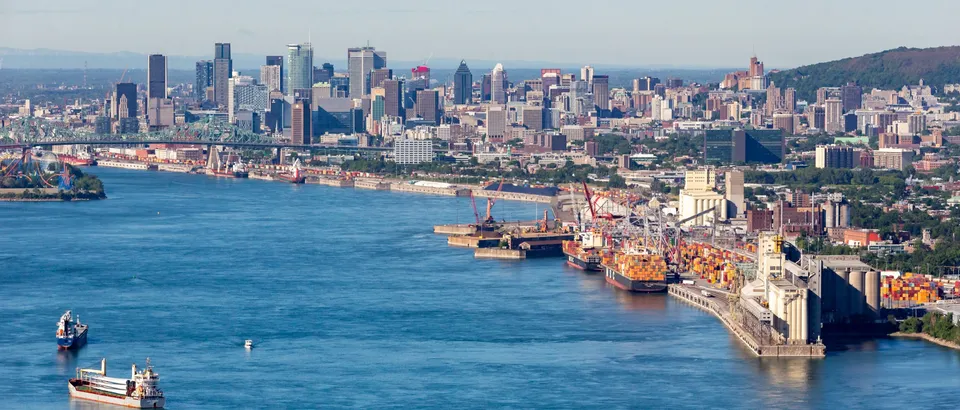
The Port of Montreal spans 15 kilometres along the north shore of the St. Lawrence River, in the heart of Montreal — Canada’s second-largest city and the economic capital of Quebec. As the terminus of the St. Lawrence Seaway, the port connects ocean shipping with the Great Lakes system, while its strategic position places it within a one-day trucking radius of more than 100 million North American consumers.
Service Region
- Quebec heartland: Montreal itself is a market of 4.3 million people, with the broader Quebec market of 8.7 million reachable within hours.
- Ontario & Toronto: The Toronto-Hamilton corridor — Canada’s largest consumer market — is served by daily rail departures in 1–2 days and overnight trucking.
- US Northeast & Midwest: CN and CPKC rail connections reach Chicago (2–3 days) , Detroit (1–2 days) and the US Northeast (3–4 days), making Montreal a highly competitive alternative to US East Coast ports.
- Atlantic Canada: The port connects to New Brunswick, Nova Scotia and Newfoundland through rail and highway corridors.
Port Terminals
The Montreal Port Authority (MPA) operates a landlord model, with private operators managing terminal facilities. The port’s container operations centre on two major terminals with combined capacity exceeding 2 million TEUs.
Major Container Terminals
-
Cast Terminal (Termont Montreal): One of the port’s two main container terminals, operated by Termont (a joint venture of Logistec and CN). With over 900,000 TEUs of annual capacity, the terminal features 8 ship-to-shore cranes, 9,000+ TEUs of on-terminal storage, and direct on-dock rail connections. It serves as a primary call for Asia-Europe services.
-
Racine Terminal (Montreal Gateway Terminals Partnership): The port’s other major container terminal, operated by MGT Partnership (a joint venture of DP World and Caisse de dépôt). With capacity exceeding 1.1 million TEUs annually, Racine features 9 ship-to-shore cranes, 18,000+ TEUs of storage and on-dock rail. It handles the largest vessels calling Montreal (up to 14,000 TEU capacity) and serves as the primary hub for Asia services.
-
Bickerdyke & Maisonneuve Terminals: Mixed-use facilities handling breakbulk, project cargo and general cargo, providing flexible capacity for non-containerized shipments.
All container terminals feature on-dock rail access, enabling direct vessel-to-railcar transfers that bypass truck drayage and move containers to Ontario and the US Midwest within days.
Shipping Routes to This Port
Montreal is served by both direct Asia services (via the Suez Canal or Panama Canal) and transshipment services through Mediterranean, Northwest European and Caribbean hubs.
Direct Asia Services (via Suez Canal)
Several carrier alliances operate direct Asia–Montreal services via the Suez Canal, with transit times of approximately 28–35 days from Shanghai, Ningbo and Shenzhen. These services typically call at Mediterranean transshipment hubs (such as Algeciras, Valencia or Gioia Tauro) en route.
From Shanghai
Shanghai is the largest origin for Montreal-bound cargo, with weekly direct services via the Suez Canal and transshipment options via Mediterranean hubs. Direct transit takes approximately 28–33 days; transshipment adds 5–10 days.
From Ningbo
Ningbo-Zhoushan offers weekly services to Montreal via Suez routes, with transit times of approximately 29–34 days. As a major export hub for machinery and consumer goods, Ningbo is a key origin for Montreal’s container volume.
From Shenzhen (Yantian / Shekou)
Shenzhen connects to Montreal via weekly Suez services with transit times of approximately 30–35 days, and via transshipment through Hong Kong or Mediterranean hubs.
Alternative Routing via West Coast
For time-sensitive cargo, importers can ship to Vancouver or Prince Rupert (12–16 days) and move containers by rail to Montreal in 4–5 days — a total of 16–21 days door-to-port. This hybrid route is often faster than all-water services, though at higher cost.
Transit Time from China to Montreal
Montreal’s all-water transit times from China are longer than West Coast routes, but the port’s inland location shortens the final trucking leg:
| Origin Port | All-Water Transit to Montreal | Sailing Frequency |
|---|---|---|
| Shanghai (via Suez) | 28–33 days | Weekly |
| Ningbo (via Suez) | 29–34 days | Weekly |
| Shenzhen (via Suez) | 30–35 days | Weekly |
| Shanghai → Vancouver → Rail | 16–21 days total | Daily (Vancouver) |
The all-water route offers the lowest cost but longest transit; the West Coast rail hybrid is faster but more expensive. For LCL (Less-than-Container-Load) shipments, add 3–5 days for consolidation and deconsolidation. Winter conditions can occasionally affect transit schedules, though icebreaker support keeps the port operational year-round.
Shipping Cost from China to Montreal
Ocean freight rates from China to Montreal reflect the longer all-water transit versus West Coast ports, plus Montreal-specific port charges.
Factors Affecting Freight Rates
- Route choice: All-water Suez services are typically $200–$500 lower per container than West Coast + rail hybrids, but take 10–15 days longer. The hybrid route offers faster delivery at a premium.
- Seasonality: Peak season (August–October) rates can increase 30–50%. Chinese New Year (January/February) creates a pre-holiday rush followed by a post-holiday rate dip.
- Container type and size: 40’ standard containers offer the best per-unit economics. High-cube, 20’ and specialized equipment (reefer, open-top, flat-rack) command premiums.
- Port fees: Montreal charges wharfage, dockage and terminal handling fees. Budget $200–$350 per container depending on timing and terminal.
How to Lower Your Shipping Costs
| Strategy | Potential Impact |
|---|---|
| Compare all-water vs. West Coast rail hybrid | Choose the right cost-speed balance for your cargo |
| Ship FCL instead of LCL | 30–50% lower per-unit freight cost |
| Book during off-peak (March–July) | 20–40% rate reduction |
| Use on-dock rail to Ontario/US Midwest | Eliminate drayage, reduce door-to-door transit cost |
| Consolidate with a China-based forwarder | Access to volume-negotiated carrier rates |
Partnering with a China-based freight forwarder like DANTFUL gives importers access to competitive carrier contracts, consolidated rates and expert guidance on Montreal terminal procedures and Canadian customs clearance.
Warehousing Services
The Montreal region is Eastern Canada’s largest warehousing and distribution market, with industrial clusters in the city’s east end, Laval and the South Shore.
Bonded Warehousing
Canada’s Customs Bonded Warehouse program allows importers to store goods without immediate payment of duties and taxes. Duties are deferred until goods leave the bonded facility for domestic consumption — valuable for seasonal inventory, quality inspections and value-added processing (labeling, kitting, repackaging) before final distribution.
Overseas Warehousing & 3PL
Greater Montreal offers comprehensive third-party logistics services for China-to-Canada importers:
- Container deconsolidation and transloading from 40’ ocean containers into 53’ domestic trailers
- Amazon FBA preparation and direct-to-fulfillment-center delivery
- Pick-and-pack e-commerce fulfillment with same-day order processing
- Cross-docking and e-commerce returns processing
Warehousing & Distribution Strategy
For importers targeting Quebec, Ontario or the US Northeast, warehousing near Montreal delivers key advantages: shorter inland trucking distances than Halifax, dual-rail access to Toronto and Chicago, and same-day delivery across the Montreal region. The port’s inland location means containers arrive closer to end markets, reducing the total inland transportation cost.
DANTFUL partners with vetted warehouses across the Montreal metro area, offering end-to-end logistics including inventory management, FBA prep, labeling, kitting and last-mile delivery coordination.
Frequently Asked Questions
Q: Is Montreal or Halifax better for China imports?
A: Montreal is larger (1.8M vs ~600K TEUs) with dual-rail redundancy (CN + CPKC) and closer proximity to the Quebec-Ontario consumer heartland. Halifax offers deeper water (accommodating larger vessels) and shorter ocean transit from Suez routes. For cargo destined for Ontario, Quebec or the US Midwest, Montreal’s rail connectivity is usually decisive; Halifax is preferred for Atlantic Canada or as a congestion alternative.
Q: How long does customs clearance take at the Port of Montreal?
A: With properly pre-filed documentation through CBSA’s Single Window and CARM systems, customs release typically takes 1–3 business days. Importers enrolled in the PARS program benefit from faster clearance and reduced inspection rates.
Q: What is the cheapest way to ship from China to Montreal?
A: All-water FCL via the Suez Canal during off-peak season (March–July) is the most cost-effective option. For time-sensitive cargo, the West Coast rail hybrid (Vancouver/Prince Rupert + CN/CPKC rail) delivers faster at a premium.
Q: Does Montreal freeze in winter?
A: The port operates year-round with the support of Canadian Coast Guard icebreakers. Winter conditions can occasionally slow vessel transit in the St. Lawrence, but the port itself remains operational throughout the year.
Q: Can I ship to Amazon FBA through Montreal?
A: Yes. Montreal is a key gateway for Amazon FBA inventory destined for fulfillment centers in Ontario and Quebec. Your forwarder ships LCL/FCL to the port, clears customs and trucks or rails to FBA facilities.